
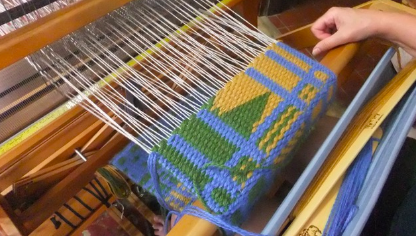
Weaving Studio
Home for textile, fiber art in central vermont
The White River Craft Center Weaving Studio has been active since 2002, with generations of students, artists, and local weavers learning and creating here. From the early days of WRCC, the Friday Weavers group has helped build the studio, care for equipment, and grow fiber arts programming through shared knowledge, donated materials, and a deep commitment to community.
Today, we’re building on that foundation with three ways to engage with textiles at WRCC: Workshops, Studio Membership, and Study Groups.
Our Textiles Community
Inspiration and Belonging: WRCC’s weaving studio has been the creative home of local textile artists for more than two decades. You’ll be in the company of weavers and fiber artists from a range of backgrounds and artistic practices–some professional and some who weave or craft for their own enjoyment. Our bright, welcoming studio is an intergenerational space for learning and creativity. While Studio Membership does not include formal instruction or classes, weaving in a community setting offers the opportunity to make artistic connections and learn from each other.
-
Community studios provide weavers with a chance to try out multiple looms and styles of weaving without investing in equipment of one’s own. Our library includes floor, inkle, frame, rigid heddle, tapestry and table looms. Rather than taking a chance purchasing a used loom that may or may not fit your needs, weavers can learn which loom technologies best fit the scale of their body and arts practice.
-
There are many items that make weaving easier but aren’t needed on a daily basis. At the WRCC Fiber Studio, we have a library fiber tools, from spinning wheels and warping boards to fringe winders, irons and a hot mangle. Membership in a community studio means that you can get basic training on these tools and access them as needed, rather than having to purchase them.
-
We maintain an extensive supply closet of common weaving fibers, including wool, cotton, linen and acrylic blends in a variety of weights. Studio members can choose a monthly allowance of yarn (by gram weight) and purchase additional materials at a reduced cost for in-studio use. This allows new weavers to explore and experiment with fibers or color combinations without purchasing whole cones from yarn suppliers.
-
Studio space and weaving tools can be costly. For textile artists with limited budgets or small living spaces, community studios provide access to professional equipment maintained by experienced fiber artists and a monthly allowance of yarns for in-studio use. Rather than having to purchase equipment, community studios allow weavers to select what need, as each project requires. Some artists view community studio membership as a first step towards establishing their own studio spaces, but others find that community studios fully meet their arts practice and creative needs.
Instructors
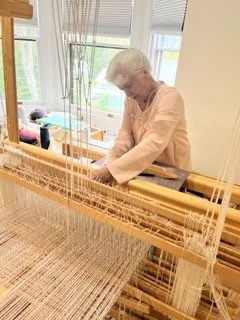
Susan Rockwell, Weaving Instructor
Pamela Wilson is a visual artist working in textiles, pigments and ceramics. She focuses on place-based making, materials studies and traditional handcraft techniques. In addition to making and exhibiting throughout New England, she organizes art-gatherings and third-space art experiences that invite participants to engage in collective handwork and intergenerational learning. Her current third-space projects include long-term residencies at the Aldrich Public Library, the White River Craft Center and Green Mountain Linen. Her work is available to view at www.pamelalynnwilson.com and on Instagram at @pamelawilsonstudio.
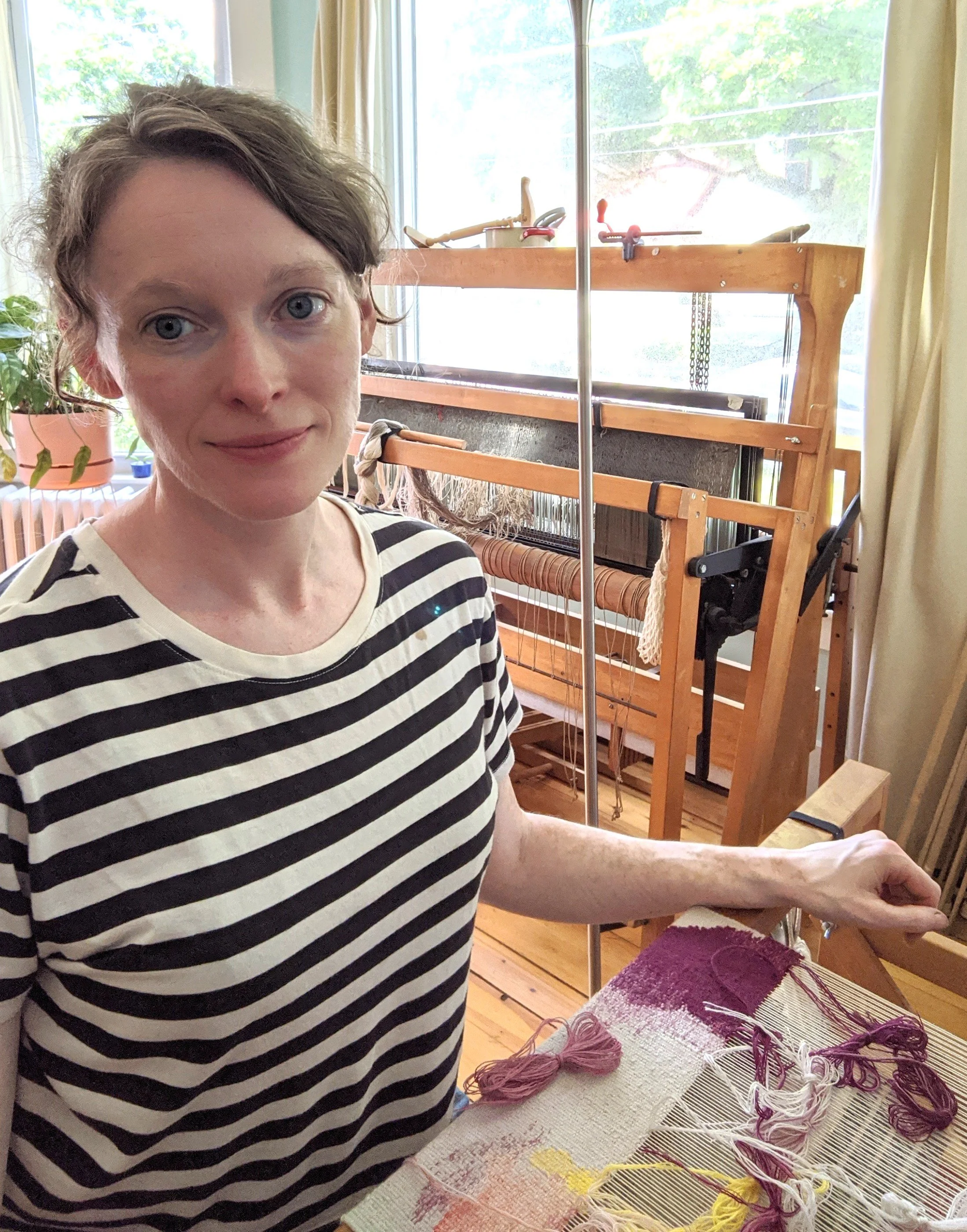
Pamela Wilson, Studio Manager
Pamela Wilson is a visual artist working in textiles, pigments and ceramics. She focuses on place-based making, materials studies and traditional handcraft techniques. In addition to making and exhibiting throughout New England, she organizes art-gatherings and third-space art experiences that invite participants to engage in collective handwork and intergenerational learning. Her current third-space projects include long-term residencies at the Aldrich Public Library, the White River Craft Center and Green Mountain Linen. Her work is available to view at www.pamelalynnwilson.com and on Instagram at @pamelawilsonstudio.
Textile Study Groups
Study groups provide an opportunity to learn collaboratively with other artists. Organized around a broad topic, like working with color, natural fibers or weave structure, your facilitator provides a brief talk each session along with creative prompts and resources. Students follow up with their own research and creative exploration at home, and gather again at the next session to share what they’ve learned. This model provides participants with loose structure and guidance, which they apply to their own specific textile interests. For artists who appreciate collective knowledge-building or open-ended prompts, study groups provide structure, fellowship and gentle accountability.
-
A 6-session study group for the textile-curious.
This study group is a good match for complete newbies, confident weavers seeking to get out of their comfort zone and art-lovers who want to explore working with thread and yarn. The facilitator will provide an opening creative prompt and 30-minute mini-lecture on the topic of the week, with areas to explore in-between sessions. Participants are invited to explore the week’s topic with materials provided, bring projects from home to work on in a group setting and learn from one another.
Fluff: Exploring fiber up close to understand its different properties
Twist: Building yarns and unconventional weave-friendly materials
Interlacing: Exploring weft, warp and interlacing
Color: Color blending, dying and getting the correct hues where you want them
Tension: Loom technology and history
Collaborative/Community Weaves: Playful approaches to weaving
-
A 6-session study group for textile artists who want to branch out in their technique and design processes
This group is a good match for textile artists who would like to push themselves to explore structure in conventional and unconventional ways. It is best suited for participants who have a basic understanding of the vocabulary of weaving. The facilitator will provide an opening creative prompt and 30-minute mini-lecture on the topic of the week, with areas to explore in-between sessions. Participants are invited to explore the week’s topic with materials provided, bring projects from home to work on in a group setting and learn from one another.
Understanding Weaving Drafts as a Language: A historical perspective on drafting
Plainweave as a Starting Point: Adding complexity to binary weave structures
Unconventional Warp & Weft: Designing for discontinuous weft and supplemental warp
Weaving from an Image: Building Pictures on a variety of warp structure
Intuitive Design for Complex Weaves: Making it up as you go along
Fiberworks, AdaCad and Computer-based Drafting: Pre-weaving design and drafting optionsDescription text goes here
Upcoming Weaving Workshops
Our weaving and textile classes provide a deep dive into a particular topic or technique, like weaving on a harness loom, fabric printing or doubleweave. Classes are focused and your instructor will provide a structured curriculum designed to support your skill development in a particular area of study. Classes are organized by technique and experience level. If you’re a beginner or not sure that a class is a good match for your skill level, just ask us!
Students will learn how to use a loom, measure a warp, dress the loom, and weave a sampler of different weave patterns, yarns and colors. The course will include the preparation and interpretation of weaving drafts and planning and completing a project from beginning to end. Participants will be introduced to resources that will help continuing weaving at home.
For intermediate weavers interested in participating, you may contact the instructor with a project you would like to weave. The instructor will guide you through your independent project.
This is a two part class (28 Hours) taught over two weekends.
Feb 21 & 22 and Mar 7 & 8 - (Saturday & Sunday 9am - 4pm)
The date of the last two hours of class will be determined by the students. These two hours consists of returning the loom and a showing of your final woven project.
Cost: $475
Register online here or contact Program Manager, Susan Cornick susan@whiterivercraftcenter.org to arrange payment by check or cash
Monthly: $30/Month
Weaving Studio Memberships
Open studio membership is designed for artists who are familiar with the basics of a weaving practice, either through a foundations class or their own self-study. This option provides space and loom/tools access in our weaving studio, along with a monthly allowance of yarn for in-studio use.